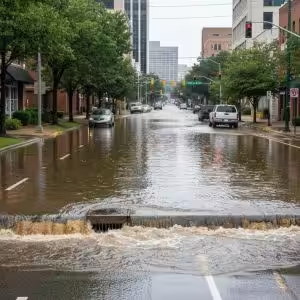
Charlotte property owners are facing a new era of risk. Climate forecasts show that by 2050, the city could see about 40 days each year with temperatures over 95.6 degrees Fahrenheit—up from just 7 days in 1990. That number might sound shocking, but temperature is not the only problem. From cybersecurity threats to overwhelmed city infrastructure, the real challenges are coming from unexpected directions—and the old ways of preparing just will not cut it anymore.
Table of Contents
- Understanding Disaster Risks In Charlotte Nc
- Core Elements Of An Effective Disaster Recovery Plan
- Disaster Recovery For Insurance And Legal Professionals
- Tips For Businesses And Homeowners In Charlotte Nc
Quick Summary
| Takeaway | Explanation |
|---|---|
| Understanding Disaster Risks | Property owners should recognize the diverse risks posed by climate change, urban development, and technological hazards in Charlotte, leading to the need for proactive risk management strategies. |
| Core Elements of a Recovery Plan | Establishing a dedicated recovery team, comprehensive documentation, and leveraging technological solutions are crucial for creating an effective disaster recovery plan that can adapt to various emergencies. |
| Immediate Post-Disaster Actions | Following a disaster, it is essential to conduct systematic damage assessments, document losses meticulously, and understand the insurance claims process to facilitate efficient recovery. |
| Financial Navigation Post-Disaster | Property owners must be informed about their insurance coverage, maintain detailed expense records, and explore available financial assistance programs to ensure effective recovery efforts. |
| Technological Resilience | Developing robust technological solutions, including cloud backups and cybersecurity measures, is vital for enhancing disaster response and recovery capabilities for both businesses and homeowners in Charlotte. |
Understanding Disaster Risks in Charlotte NC
Charlotte property owners face a complex landscape of potential natural and human-induced disasters that demand proactive preparation and strategic risk management. The geographic location and climate characteristics of the region create unique challenges for disaster resilience.
Climate Change and Extreme Weather Patterns
Climate data reveals a critical trend for Charlotte residents. Climate Check projects significant environmental shifts that dramatically increase disaster vulnerability. By 2050, the city is expected to experience approximately 40 days annually with temperatures exceeding 95.6ºF, compared to just 7 days in 1990. This dramatic temperature increase signals escalating risks of heat-related emergencies, drought conditions, and potential infrastructure stress.
The region encounters multiple severe weather threats including:
- Hurricanes: Coastal proximity increases vulnerability to intense storm systems
- Flooding: Urban development and changing precipitation patterns heighten water damage risks
- Severe Thunderstorms: Frequent electrical storms pose significant property damage potential
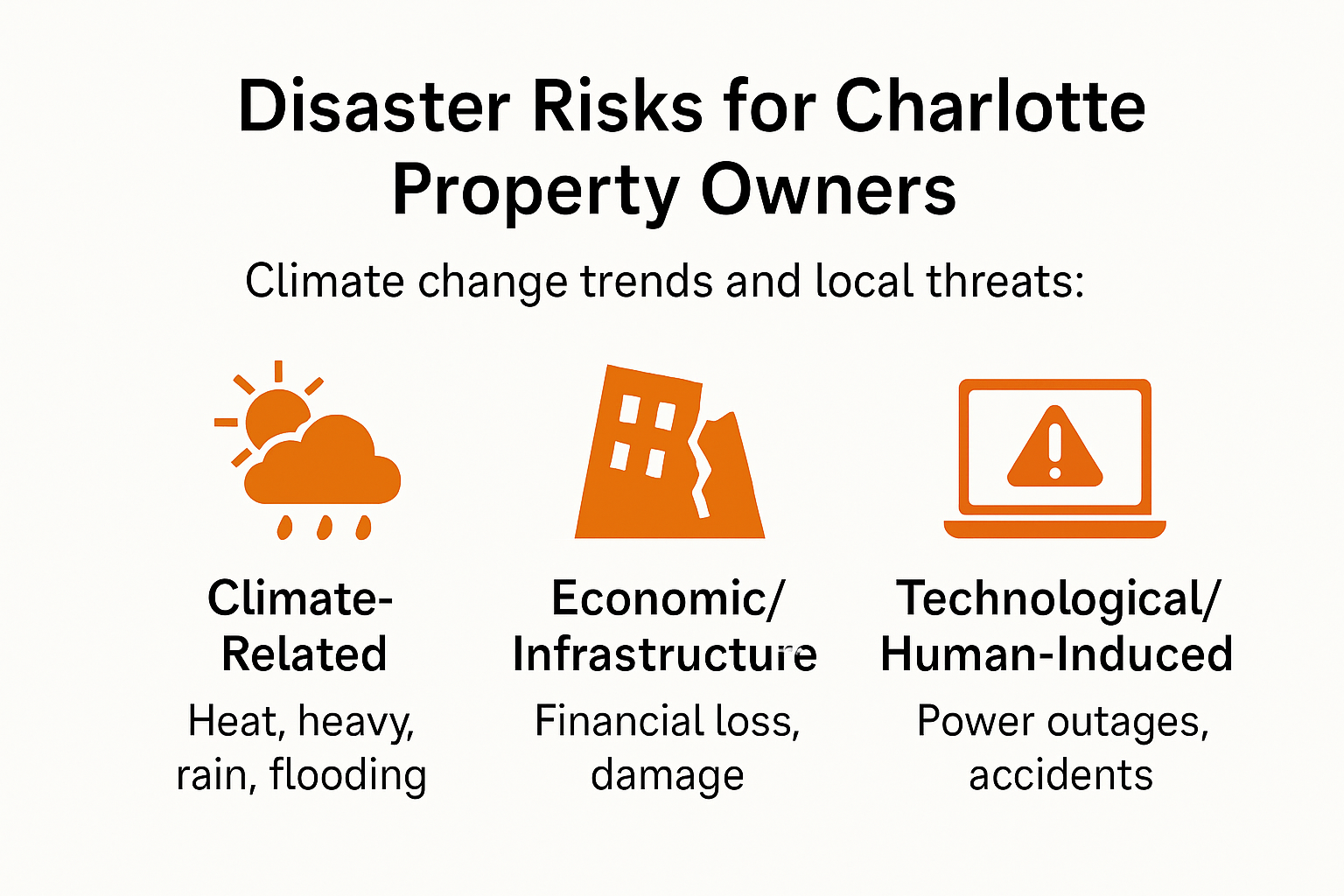
To provide a clearer overview of Charlotte’s rising climate risks, the table below summarizes the key weather-related threats and projected temperature trends mentioned in this section:
| Threat | 2050 Projection/Trend | 1990 Comparison | Impact |
|---|---|---|---|
| Extreme Heat Days | ~40 days > 95.6ºF/year | 7 days/year | Increased heat-related emergencies |
| Hurricanes | Increased vulnerability | Ongoing | Intense storms, wind, flooding risks |
| Flooding | Heightened by urban development | Growing concern | Water damage to properties, infrastructure |
| Severe Thunderstorms | Frequent electrical storms | Persistent | Potential significant property damage |
Economic and Infrastructure Vulnerability
Disaster risks extend beyond environmental factors. Charlotte’s rapid urban development creates complex infrastructure challenges that amplify potential damage scenarios. Federal Emergency Management Agency research indicates that metropolitan areas with accelerated growth often struggle with resilient emergency response systems.
Property owners must recognize that disaster recovery goes beyond immediate restoration. The economic implications of disrupted services can cascade through personal and community systems, creating long-term financial strain. Understanding these interconnected risks becomes crucial for comprehensive disaster preparedness.
Emerging Technological and Human-Induced Risks
Beyond natural disasters, Charlotte property owners must also consider technological and human-induced risks. Cybersecurity threats, infrastructure failures, and potential industrial accidents represent significant potential disruption vectors. National Risk Management Center studies highlight the increasing complexity of urban risk landscapes.
Effective disaster recovery basics require a holistic approach that integrates environmental monitoring, infrastructure assessment, and adaptive planning strategies. Property owners who develop comprehensive risk understanding position themselves for more resilient and responsive recovery processes.
To gain deeper insights into navigating these complex challenges, read our comprehensive guide on disaster recovery strategies.
Core Elements of an Effective Disaster Recovery Plan
Developing a comprehensive disaster recovery plan is critical for Charlotte property owners to minimize potential damages and ensure rapid, organized response during emergencies. An effective strategy goes beyond simple documentation and requires strategic planning, clear communication, and adaptive frameworks.

Establishing a Dedicated Recovery Team
A robust disaster recovery plan starts with assembling a dedicated team with clearly defined roles and responsibilities. Never Blue IT emphasizes that establishing a structured recovery team is crucial for coordinated emergency responses. This team should include members with diverse skills such as emergency management, communication, technical expertise, and logistical coordination.
Key team member responsibilities typically include:
- Emergency Coordinator: Oversees plan activation and overall response strategy
- Communication Specialist: Manages internal and external communication channels
- Technical Recovery Lead: Handles infrastructure and technology restoration
- Resource Management Coordinator: Tracks and allocates critical resources
To make team roles and their main responsibilities more accessible, here is a summary table outlining the core disaster recovery team structure:
| Role | Main Responsibility |
|---|---|
| Emergency Coordinator | Oversee plan activation and response strategy |
| Communication Specialist | Manage internal/external communication channels |
| Technical Recovery Lead | Restore infrastructure and technology |
| Resource Management Coord. | Track and allocate critical resources |
Comprehensive Documentation and Risk Assessment
Documentation forms the backbone of an effective disaster recovery plan. University of Missouri System recommends creating a clear policy statement that outlines recovery goals, specifies activation authority, and details task organization for each team member.
A thorough risk assessment should include:
- Identification of potential disaster scenarios specific to Charlotte
- Evaluation of infrastructure vulnerabilities
- Potential economic and operational impact analysis
- Prioritization of critical systems and recovery sequences
Regular training and periodic plan reviews ensure the strategy remains current and adaptable to changing circumstances. Property owners should conduct comprehensive simulations to test and refine recovery protocols.
Technology and Communication Infrastructure
Modern disaster recovery plans must integrate robust technological solutions and communication frameworks. This involves establishing redundant communication channels, securing critical data backups, and creating flexible response mechanisms that can adapt to rapidly changing scenarios.
Technology considerations include:
- Cloud-based data backup systems
- Redundant communication platforms
- Mobile response capabilities
- Real-time tracking and reporting mechanisms
For property owners seeking professional guidance in developing a comprehensive disaster recovery strategy, explore our detailed restoration planning resources.
Successful disaster recovery is not about perfect prediction but about creating resilient, adaptable systems that can respond effectively when unexpected challenges emerge.
Disaster Recovery for Insurance and Legal Professionals
Insurance and legal professionals in Charlotte play a critical role in disaster recovery processes, serving as essential support systems for property owners navigating complex post-disaster scenarios. Their strategic approach to disaster management requires specialized skills, comprehensive planning, and adaptive response mechanisms.
Strategic Planning and Documentation
The Washington State Bar Association emphasizes the importance of comprehensive disaster recovery planning for legal professionals. This involves identifying common risk areas, implementing prevention techniques, and establishing clear protocols for unexpected events.
Key documentation considerations include:
- Comprehensive Risk Assessment: Detailed analysis of potential disaster scenarios
- Client Communication Protocols: Clear guidelines for maintaining client contact
- Operational Continuity Strategies: Mechanisms for maintaining service delivery during disruptions
- Data Protection Frameworks: Secure backup and recovery systems for sensitive information
Insurance Claims and Legal Response Mechanisms
The Insurance Information Institute advises developing formal written disaster recovery plans that detail specific response and recovery strategies. Insurance adjusters and attorneys must create robust frameworks that enable swift, efficient action during crisis situations.
Critical response components include:
- Immediate damage assessment procedures
- Comprehensive documentation of property condition
- Clear communication channels with property owners
- Expedited claims processing mechanisms
Technology and Operational Resilience
The American Bar Association outlines a three-phase approach to disaster recovery: Activation/Notification, Recovery, and Reconstitution. This framework highlights the necessity of pre-established plans to effectively restore operations and mitigate future risks.
Technological preparedness involves:
- Cloud-based document management systems
- Redundant communication infrastructure
- Secure offsite data storage solutions
- Mobile response capabilities
For professionals seeking comprehensive guidance on navigating complex disaster recovery scenarios, explore our specialized restoration support resources.
Successful disaster recovery for insurance and legal professionals demands a proactive, integrated approach that prioritizes client support, operational flexibility, and technological resilience.
Tips for Businesses and Homeowners in Charlotte NC
Property owners in Charlotte face unique challenges during disaster recovery, requiring strategic preparation, proactive risk management, and comprehensive response strategies. Understanding the nuanced approaches for businesses and homeowners can significantly impact recovery efficiency and long-term resilience.
Immediate Post-Disaster Assessment and Documentation
Small Business and Technology Development Center emphasizes the critical importance of systematic damage assessment and documentation. Immediate actions following a disaster can dramatically influence insurance claims, recovery timelines, and financial outcomes.
Key documentation strategies include:
- Photographic Evidence: Comprehensive visual documentation of damage
- Detailed Inventory: Systematic recording of damaged property and assets
- Preservation of Damaged Materials: Maintaining evidence for insurance claims
- Immediate Mitigation Steps: Preventing further property deterioration
Financial and Insurance Navigation
Successful disaster recovery hinges on strategic financial planning and insurance claim management. Property owners must understand their policy coverage, claim submission processes, and potential financial assistance programs.
Critical financial considerations include:
- Understanding policy limits and exclusions
- Documenting all disaster-related expenses
- Exploring federal and state disaster relief programs
- Maintaining clear communication with insurance providers
- Tracking all repair and restoration expenditures
Technological and Infrastructure Resilience
Modern disaster recovery demands robust technological infrastructure and adaptive strategies. Businesses and homeowners must develop comprehensive continuity plans that integrate digital solutions and flexible response mechanisms.
Technology and infrastructure recommendations:
- Cloud-based data backup systems
- Redundant communication platforms
- Emergency power generation capabilities
- Mobile work and recovery solutions
- Cybersecurity protection during recovery
Learn more about comprehensive disaster recovery strategies tailored for Charlotte property owners.
Effective disaster recovery is not about eliminating risks but developing adaptive, resilient systems that transform challenges into opportunities for renewal and improvement.
Frequently Asked Questions
What are the main disaster risks facing property owners in Charlotte?
Charlotte property owners face various risks including extreme heat due to climate change, hurricanes, flooding from urban development, and severe thunderstorms.
How can I prepare an effective disaster recovery plan for my property?
An effective disaster recovery plan includes establishing a dedicated recovery team, conducting a comprehensive risk assessment, and utilizing technology for communication and data backup.
What are the immediate actions I should take after a disaster occurs?
Immediately after a disaster, conduct a systematic damage assessment, document losses with photographs and inventory lists, and take steps to mitigate further damage to your property.
How can I navigate the insurance claims process after a disaster?
Understand your insurance policy details, document all disaster-related expenses, and maintain communication with your insurance provider to facilitate a smooth claims process.
Take Control of Disaster Recovery and Protect Your Charlotte Property
If reading about the rising risks and complex challenges in disaster recovery has left you feeling uncertain, you are not alone. The stress of navigating insurance claims, documenting losses, and handling both the immediate and long-term effects of storms or floods can overwhelm any property owner. The article highlights how essential it is to act quickly and follow a clear recovery plan. You deserve guidance and practical solutions when every decision matters most.
Let National Insurance Claim Specialist (NICS) stand by your side as you move from worry to action. Our experts specialize in disaster recovery for Charlotte homeowners and businesses, focusing on fair insurance claims and rapid restoration after events like hurricanes, fires, floods, and more. We use the latest technology and proven documentation strategies, just like those mentioned in the article, to make sure you get the support and compensation you need. Do not wait for the next disaster to catch you off guard. Start your personalized recovery journey today by visiting National Insurance Claim Specialist or discover more about our step-by-step recovery support for disaster recovery services in Charlotte. Take the first step toward restoring your property and your peace of mind.
Recommended
- Charlotte Restoration: Find Top Disaster Recovery Services
- Rebuilding Lives: Understanding the Significance of Restoration Services After a Disaster – Fire Damage Repair and Water Damage Repair Charlotte NC
- Expert Fire Damage Restoration Services – Fire Damage Repair and Water Damage Repair Charlotte NC
- Unmatched Excellence: Why National Insurance Claim Specialist is Your Top Choice – Fire Damage Repair and Water Damage Repair Charlotte NC
- Mastering the Claim Process: How to File for Roof Damage – Fire Damage Repair and Water Damage Repair Charlotte NC
- NIC’s Restoration: Your Trusted Restoration Experts